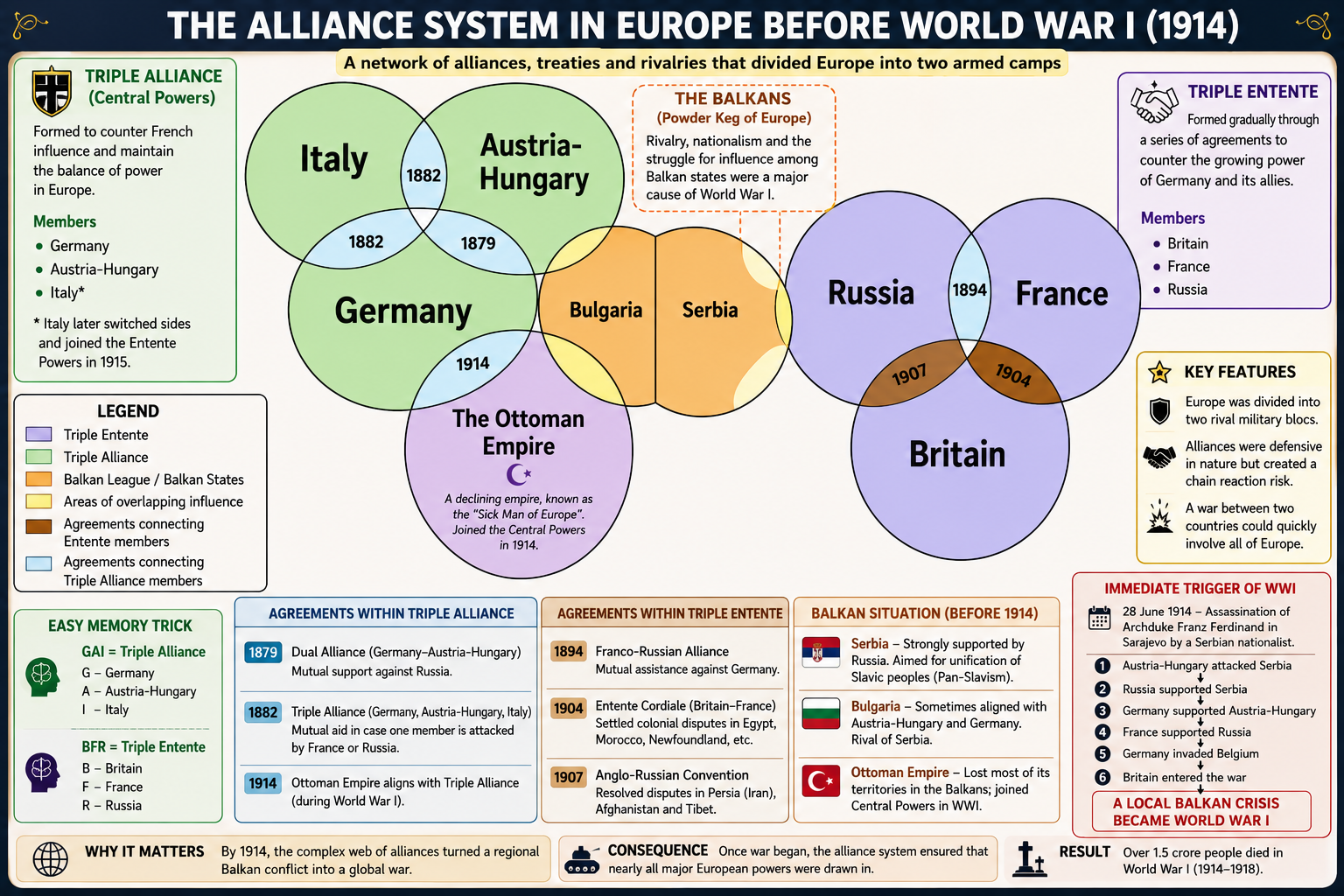
Alliance System in Europe before World War I (1914). The diagram illustrates the rival alliance blocs—the Triple Alliance (Germany, Austria-Hungary, and Italy) and the Triple Entente (Britain, France, and Russia)—along with the Balkan tensions and treaty network that contributed to the outbreak of World War I.
Balkans
The Balkan Peninsula in Southeastern Europe. The region has historically been characterized by ethnic diversity, nationalism, and strategic competition among major powers, earning the title ‘Powder Keg of Europe’ before World War I.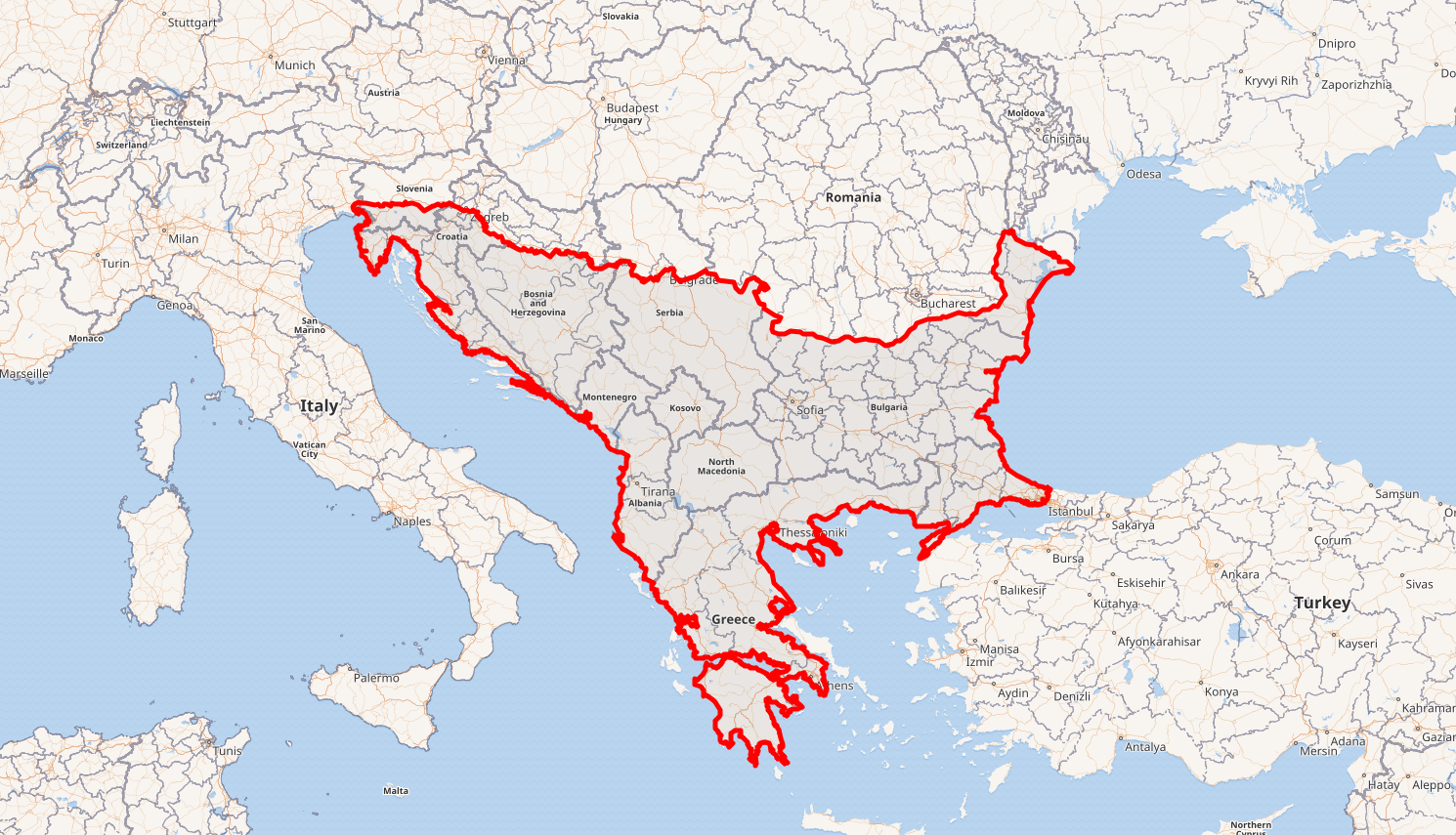
Alliance System in Europe Before World War I (1914)
This diagram illustrates the major alliance systems in Europe before the outbreak of World War I in 1914. Each circle represents a country, while the overlapping sections represent treaties or alliances. The years indicate when these agreements were signed.
What the Colors Mean
🟩 Triple Alliance (Central Powers Bloc)
- Germany
- Austria-Hungary
- Italy
🟦 Triple Entente
- Britain
- France
- Russia
🟨 Balkan States
- Serbia
- Bulgaria
🟪 Ottoman Empire
- Initially outside the major alliance blocs
Triple Alliance
Dual Alliance (1879)
The overlap labeled 1879 represents the Dual Alliance between Germany and Austria-Hungary.
Key Features:
- Mutual support against Russia.
- Formed the foundation of German foreign policy under Chancellor Otto von Bismarck.
Triple Alliance (1882)
The overlap labeled 1882 represents the Triple Alliance.
Members:
- Germany
- Austria-Hungary
- Italy
Objectives:
- Counter French influence in Europe.
- Provide mutual military assistance.
UPSC Note: Italy later switched sides during World War I and joined the Entente Powers in 1915.
Triple Entente
Franco-Russian Alliance (1894)
The overlap labeled 1894 represents the Franco-Russian Alliance.
Why was it formed?
- Both countries perceived Germany as a threat.
- Germany’s central location in Europe posed a strategic challenge.
Entente Cordiale (1904)
The overlap labeled 1904 represents the Entente Cordiale between Britain and France.
Significance:
- Not initially a military alliance.
- Resolved colonial disputes between Britain and France.
Anglo-Russian Convention (1907)
The overlap labeled 1907 represents the Anglo-Russian Convention.
Issues Resolved:
- Persia (Iran)
- Afghanistan
- Tibet
Together, these agreements formed the Triple Entente:
- Britain
- France
- Russia
The Balkans: The Powder Keg of Europe
Serbia
- Strongly supported by Russia.
- Promoted Pan-Slavism and the unification of Slavic peoples in the Balkans.
Bulgaria
- Frequently aligned with Austria-Hungary and Germany.
- Regional rival of Serbia.
Ottoman Empire
- A declining empire often referred to as the “Sick Man of Europe.”
- Gradually lost territory in the Balkans.
- Joined Germany and Austria-Hungary during World War I.
Why the Alliance System Was Important
By 1914, Europe had effectively split into two rival camps.
| Triple Alliance | Triple Entente |
|---|---|
| Germany | Britain |
| Austria-Hungary | France |
| Italy* | Russia |
*Italy later joined the Entente Powers in 1915.
Consequence
The alliance system meant that a conflict involving one nation could quickly involve many others, turning a regional dispute into a continental war.
Immediate Trigger of World War I
On 28 June 1914, Archduke Franz Ferdinand, heir to the Austro-Hungarian throne, was assassinated in Sarajevo by a Serbian nationalist.
Chain Reaction
- Austria-Hungary declared war on Serbia.
- Russia mobilized in support of Serbia.
- Germany backed Austria-Hungary.
- France supported Russia.
- Germany invaded Belgium.
- Britain entered the war.
As a result, a local Balkan crisis escalated into World War I.
Quick Revision Table
| Alliance | Members |
|---|---|
| Triple Alliance | Germany, Austria-Hungary, Italy |
| Triple Entente | Britain, France, Russia |
Memory Trick
GAI = Triple Alliance
- Germany
- Austria-Hungary
- Italy
BFR = Triple Entente
- Britain
- France
- Russia
Conclusion
The alliance system divided Europe into two hostile blocs. While intended to maintain peace through deterrence, it ultimately ensured that the assassination of Archduke Franz Ferdinand in 1914 triggered a chain reaction that engulfed much of the world in war.